
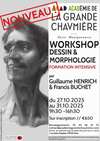
Drawing and Anatomy Workshop
Drawing andwith a live model—theory and practice
Hosted by Brancis Buchet (morphology) and Guillaume Henrich (drawing)
Intensive workshop on morphology and life drawing using the "Sight Size" method—the only one of its kind in France!
This workshop is intended for individuals who already have experience drawing from live models; a portfolio of several drawings will be required before your application is accepted.
A description of the training program is provided below.
Registration :
Please fill out the form below; we will send you an email with the details and requirements.
Upcoming dates: TBA
NUDE DRAWING CLASS (with Guillaume Henrich)
MORPHOLOGY COURSE (with Francis Buchet)
- Introduction to the Morphology / Life Drawing Course
- About Me (Professional Background)
- Hours
- Equipment
- Class Schedule
- Reviews
The morphology course offers two types of classes:
- Lecture (2 hours of theory)
- Course in Applied Anatomy (1 hour of theory + 2 hours of live model study)
A. Theoretical lecture on morphology
The lecture-style anatomy classes cover the various major regions of the body.
The class is based on a photograph of a model or a work of art
The course is structured as follows:
1. Structural analysis:
- The course begins with a descriptive analysis of the model
- Bone registration is performed by defining a reference point and establishing the three axes (x, y, z)
2. Bone description:
- The bone structures discussed are described (shapes, function, terminology)
- They are then drawn on the reference model, offering three levels of detail:
- Level 1 Schematization
- Level 2 Schematization
- Detailed representation.
3. Description of muscles and tendons:
The muscles, their tendons, and the major ligaments are gradually attached starting from their points of attachment to the skeleton.
4. Areas of fat accumulation:
The fixed and variable mass figures are placed on the final drawing.
5. Simplification of shapes:
A summary of the course is provided based on a simplification and schematization of the forms studied.
6. Photo presentation:
A series of photos related to the course is shown to the students (models, athletes, works of art).
B. Course in Applied Morphology
The applied morphology courses consist of four course series:
- Lecture 1: Introduction to Morphology
- 5 classes: Drawing Basics
- 10 lessons: The Skeletal Structure of the Human Body
- 15 lessons: Muscular anatomy of the human body
Classes generally proceed as follows:
• 1. Descriptive analysis of the region under study
- Skeletal structure (7 sessions)
- Muscle structure (15 sessions)
• 2. Simplification of the form: proposal of one or more schematic representations of the region under study
• 4. Identifying and reading from a live model
• 5. Life drawing session:
2 x 45-minute sessions of drawing from a live model
Suggested exercises tailored to the region being studied
Individual exercises will be assigned to students from week to week
I. Osteology
Lesson 6: - Osteology: The Pelvis
Lesson 7: - Osteology - The Thoracic Cage
Lesson 8: - Osteology - The Skull
Lesson 9: - Osteology - The Three Fixed Volumes: Skull - Thoracic Cage - Pelvis - Spine
Lesson 10: - Osteology - The Lower Limb: Femur / Patella / Tibia / Fibula
Lesson 11: - Osteology - The Lower Limb: The Foot
Lesson 12: - Osteology - The Upper Limb: The Shoulder Girdle
Lesson 13: - Osteology - The Upper Limb: Humerus / Radius / Ulna
Lesson 14: - Osteology - The Upper Limb: Wrist / Hand
Lesson 15: - Osteology - The Complete Skeleton
II. Myology
Lesson 16: - Musculature - The Lower Limb: Thigh Extensors
Lesson 17: - Musculature - The Lower Limb: Adductors of the Thigh
Lesson 18: - Musculature - The Lower Limb: Thigh Flexors
Lesson 19: - Myology - The Lower Limb: Anterior and Lateral Muscles of the Leg and Foot
Lesson 20: - Myology - The Lower Limb: Posterior Muscles of the Leg and Foot
Lesson 21: - Musculature - Torso (front view)
Lesson 22: - Musculature - Upper Body (Back)
Lesson 23: - Musculature - Upper Limb: Arm: Shoulder Girdle / Flexors
Lesson 24: - Musculature - Upper Limb: Arm: Extensors
Lesson 25: - Musculature - Upper Limb: Forearm: Flexors
Lesson 26: - Musculature - Upper Limb: Forearm: Extensors
Lesson 27: - Musculature - The Upper Limb: Hand
Lesson 28: - Myology - The Face
Lesson 29: - Structure - Eyes - Nose - Mouth - Ear
Lesson 30: - Myology - Full Body
C. Conformation Judging Panel
Students are required to take two anatomy exams to assess their skills and pass the course:
- Assessment 1: Osteology
- Osteology Quiz (20 questions)
- Drawing of a complete skeleton (from memory)
- Assessment 2: Muscle Physiology
- Myology Quiz (30 questions)
- A full anatomical drawing done from memory
Classes are conducted live in front of the students using an iPad and a video projector.
