The Mont-Parnasse Arts District
Historically, the Mont-Parnasse district of Paris has been an artistic neighborhood, epitomizing the bohemian movement that emerged there in the 1920s following World War I.
Even today, we can still find legendary restaurants and bars, numerous movie theaters, and, above all, a multitude of small artists’ studios.
The oldest is La Closerie des Lilas, which opened in 1860 and takes its name from the Bal de la Closerie des Lilas (formerly the Bal Bullier), which was held across the boulevard de l'Observatoire until 1940. It was the meeting place of the “intransigeants,” a group of painters emerging fromCharles Gleyre’sstudio atthe École des Beaux-Arts in Paris, includingBazille,Renoir,Monet, andSisley, soon joined byPissarro, who would become theImpressionists. One also encountersÉmile Zola,Paul Cézanne,Théophile Gautier,Charles Baudelaire, and the brothersJulesandEdmond de Goncourtthere. Among the illustrious names who frequented the place: Paul Verlaine, Lenin, Guillaume Apollinaire,Ernest Hemingway,F. Scott Fitzgerald, andHenry Miller(It was on the terrace ofLa Closeriethat Fitzgerald had the manuscript of The Great Gatsby to Hemingway),Amedeo Modigliani,Germaine Tailleferre, Paul Fort,André Breton,Louis Aragon,Kees van Dongen,Pablo Picasso,Jean-Paul Sartre,André Gide,Paul Éluard,Oscar Wilde,Samuel Beckett,Man Ray,Ezra Pound, and, more recently, Jean-Edern Hallier.
The Dôme restaurant, founded by a native of Auvergne in the late 19th century, is a case in point: at the beginning of the 21st century, it was regarded as a major hub for intellectual gatherings.
La Rotonde, now a favorite haunt of journalists and other figures in the political and cultural scene, was once a daily gathering place for cash-strapped artists who came there to enjoy a cup of coffee and the warmth by the stove for a few hours, often in exchange for a painting still wet with paint. Evenings often stretched late into the night among artists, models, and intellectuals of all stripes.
A little further on, the Sélect opened its doors between the two world wars, attracting the entire Parisian intelligentsia.Scott Fitzgerald,Ernest Hemingway,Picasso, andAgnès Capriwere regulars there.
Across from Boulevard du Montparnasse, La Coupole—which opened with great fanfare in 1927 (it is said that even the vast reserves of champagne were not enough to keep up with the influx of guests)—was renowned for its wild parties during the interwar years.
This period is considered the height of Montparnasse's artistic golden age.
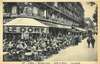
The Café du Dôme in the early 20th century
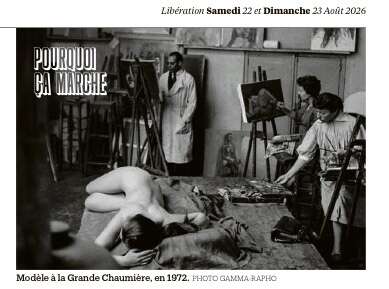
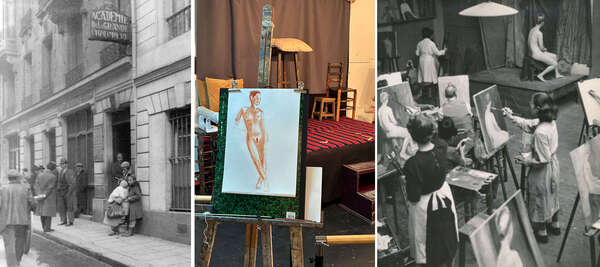
The Académie de laGrande Chaumière was also part of this scene; it allowed artists to express themselves freely whilealsoattendingclasses taught by renowned professors such as Bourdelle.
This neighborhood is steeped in history. Many artists passed through here during its golden age, around the 1920s and 1930s, leaving their mark on the area. Some of these artists stayed at the famous Hôtel des Académies et des Arts.
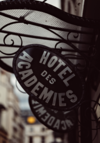
Facade of the Hôtel des Académies et des Arts
Recently renovated, this hotel has chosen to bring back to life the great artists and masterpieces associated with the history of Mont-Parnasse. Click on this link to find a description of the venue, as well as insights from the two interior designers who worked on this major renovation. It is a place that evokes Paris’s past as an artistic and cultural capital...